AI Is Making Management Skills More Important, Not Less
Editor
Heather Doshay
Category
Waypoint Works Original
Date
September 14, 2026


There is a popular prediction about the future of work that goes something like this: artificial intelligence will allow individuals to do the work of entire teams, companies will get smaller, the best individual contributors (aka “the rise of the super IC") will become extraordinarily productive, and eventually someone will build a billion-dollar company with a single employee.
There’s an assumption in this vision of the future. Some argue that smaller teams require fewer managers, and therefore, management itself will become less important.
I'm making a different bet, one where good managers are more important than ever in the future. There are two key reasons:
First, whatever AI ultimately does to organizational structure, the transition is clearly creating higher levels of uncertainty for people. Employees are growing fearful as CEOs cite AI as the reason for restructurings and layoffs. They are trying to understand how to protect themselves, anticipating how their roles will change, and what happens when skills they spent years learning can suddenly be completed in milliseconds by a computer.
Good managers are the stable container helping employees stay productive while navigating immense change. The capabilities of AI are evolving daily, and still, I believe we are only in the early innings of the game. We are not close to some conception of an “end state” where there is a clear line between the old world of work and the new world of work. The work of managers is critical to shepherding this evolution.
Second, and even more enduring: the skills that define great managers are now critical for anyone working with AI.
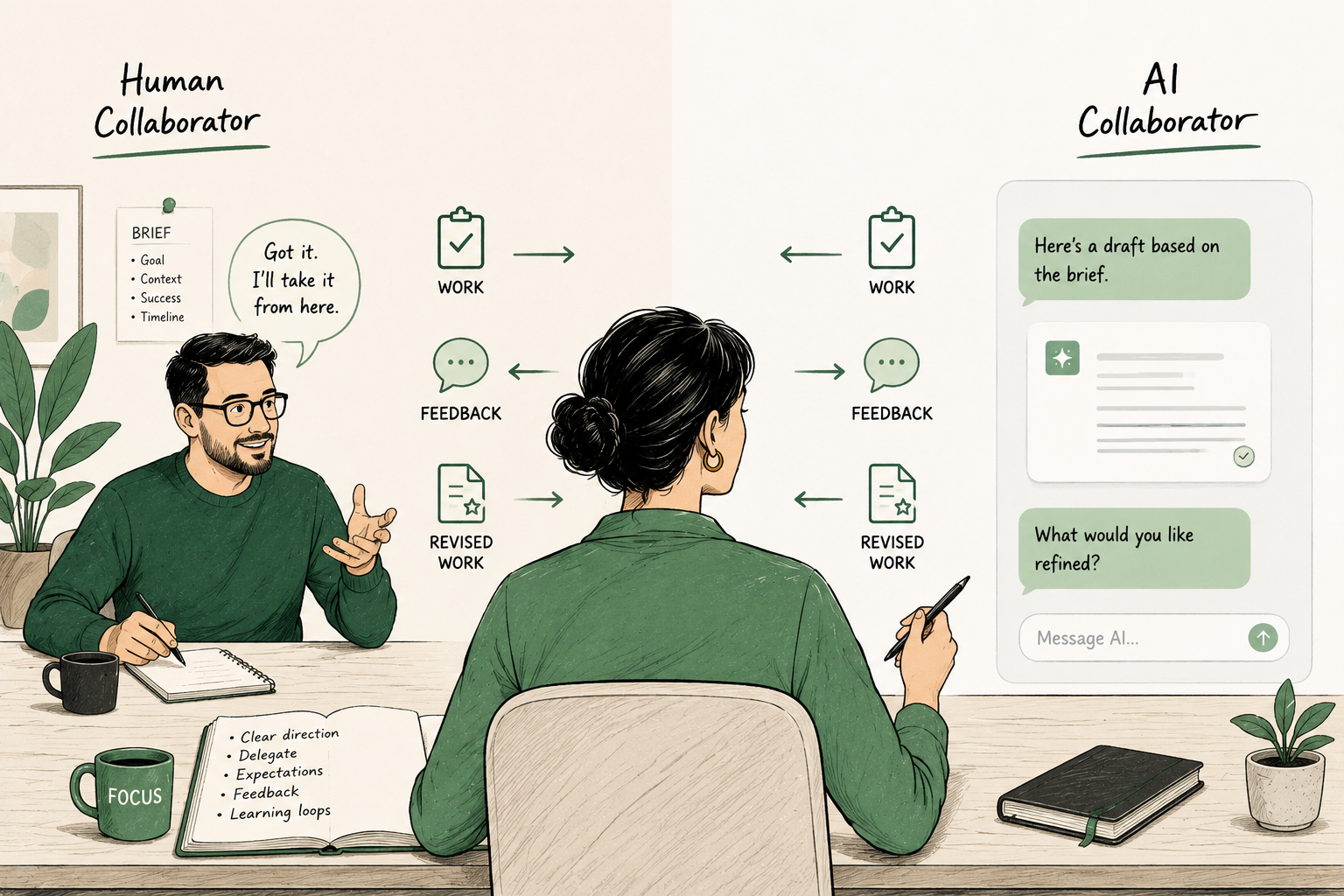
Setting clear expectations, delegating intelligently, judging the quality of someone else’s work, giving useful feedback, and creating systems that improve learning through iteration are no longer skills reserved only for people with human direct reports. They are becoming part of the standard operating system of knowledge work for all employees.
In other words, the same management skills that help people succeed with other humans often determine whether they are any good at using AI.
To be clear, I do not mean that Claude, Chat GPT, or Gemini should be treated exactly like direct reports. They are software and have no career aspirations and no feelings to bruise. The common ground here is that both people management and effective AI use require you to direct work that you are no longer doing entirely yourself, and how well you do that depends on a set of key skills.
Once you see this overlap, the parallels become hard to miss. Here are the five things that those who excel in people management and AI utilization both do well:
1. They know what great looks like
The best managers articulate what great looks like. They can discern between good and bad output of a piece of work. They have clarity and vision in what a quality output would look like even before the work is delegated. They can point to examples and explain why they are good. They can look at finished work and distinguish something that merely satisfies the assignment from something that deserves to represent the team.
For most managers, great is a fuzzy concept that lives in their head. They name what they want, hand off an assignment, and assume they will recognize the right answer when it appears. Then the work comes back and they discover that their standard was much clearer in their own head than it was to anyone else.
The AI world increasingly calls this “taste.” As generative tools make it easier to produce writing, analysis, code, design and research, the ability to generate a plausible output becomes less scarce. Judgment and discretion becomes more important. Someone still has to know whether the result is great, just okay, or awful.
Instead of asking an AI to "write a marketing email," provide three examples of your best-performing emails and explain why they worked. By showing the model exactly what you value, you give it a clear standard to emulate, rather than relying on its generic assumptions.
The same principle applies when managing people. Examples of strong work, templates, previous deliverables and clearly articulated standards allow someone else to see what you see.
This is also why expertise still matters in an AI-heavy workplace. If you cannot judge the output, producing more of it does not create leverage. A manager who cannot recognize excellent work will struggle to raise the standard of a team. An AI user who cannot recognize excellent work will accept mediocre output with impressive confidence.
2. They delegate intelligently
Understanding what "great" looks like allows you to delegate parts of the work effectively.
Delegation is usually taught as a management skill because managers have finite time. The goal for a manager is to enable them to multiply what’s possible for the team. This means they cannot personally do every task their team is responsible for, so they have to decide what to hand off, to whom, with how much autonomy, and with which checkpoints.
Just as a manager decides when to delegate to humans, many people wonder how and when to delegate tasks to AI.
For example, if writing a client proposal, you might delegate research, synthesis, and outlining to AI while personally handling the pricing strategy and sensitive client language. Alternatively, you could delegate the entire draft and focus your time on a final review.
Just as humans develop new skills over time, allowing managers to delegate more and more, the same goes for AI. The work you would never have delegated to AI two years ago may be routine today, and what’s possible two years from now will be more expansive.
This principle of delegation as a capacity builder and efficiency gain is a valuable one to develop, for managers of people and AI users alike. People who become highly effective with AI will develop a strong instinct for dividing work between themselves and the tools available to them. They will know when to use AI extensively and when the output requires they do it themselves.
Most managers have struggled with trust, the belief that it would get done better and faster if they just did it themselves, and in doing so hold a quickly outdated set of beliefs about the person (or AI) they are delegating to that keeps them from expanding the capacity of their team.
3. They set clear expectations
Business teaches leaders that concision is praise worthy. And while high signal to noise is great, often times managers are taught to be so brief that they fail to provide their reports with the necessary context to be successful.
“Put together a contract for this client” may be a grammatically complete sentence, but it leaves almost every important question unanswered. What kind of contract? What has already been agreed upon? Is there a previous contract to use as a starting point? What is unusual about this client? Who needs to review it? What would make the finished draft successful?
If you gave that assignment to a capable employee, they might ask a dozen questions before getting started. They might also make reasonable assumptions, complete the work, and discover afterward that their assumptions were wrong.
If you’ve ever given a concise but unclear prompt to an LLM, you know well how badly it completes the assignment.
Setting clear expectations matter enormously, both with humans and with AI. Some might argue that good employees shouldn’t ask questions and just do what they're told. But in reality, the best employees take total care and ownership over their work, and giving them a sense of purpose or a single sentence answering the “why” behind the ask goes a long way for motivation and for clarity.
This is the idea behind the Waypoint Works PRIME framework. Much of good management comes down to creating the conditions in which someone else can succeed. Managers must identify and transfer the specific information the other person needs to succeed.
AI prompts are an exact parallel to this management skill. Give a model a vague assignment and it will happily fill in the missing information itself. Sometimes those assumptions will be sensible, and others will be absurd. Either way, if the prompt was vague or unclear, the problem wasn’t the AI, it was the user.
4. The give actionable feedback
Even excellent delegation and clear expectations will not produce perfect work every time. People make mistakes and AI hallucinates. Thoughtful, specific, actionable feedback goes a long way in steering things back on course.
Managers often give teams feedback that communicates dissatisfaction without communicating much else. “This isn’t quite there” or “I don’t like this direction.” The recipient knows the work missed the mark but has to guess why.
People do exactly the same thing with AI.
They ask for a draft, dislike the result, and type, “No, try again.” The model produces another version based on almost no new information, gets it wrong, and the user gets increasingly annoyed. Specific, actionable feedback resolves this.
Managing AI versus humans has one big advantage: it has no feelings.
A large amount of weak management comes from discomfort. Managers soften feedback until it becomes unintelligible because they are worried about hurting someone. They avoid addressing a problem because the conversation feels awkward for them. They rewrite the work themselves because explaining what is wrong seems harder than fixing it.
None of those interpersonal concerns exist when giving feedback to a model. You can be extraordinarily direct, provided you are also specific.
That makes AI an interesting place to practice the mechanics of good feedback: say what happened, explain what is wrong with it, and describe what a better version requires.
5. They enable learning loops
Good managers expand potential by modeling excellence, delegating stretch assignments, and providing feedback that helps people uplevel their approach. They foster environments where trust is built and growth is honored.
The best managers go further by creating systems-level learning loops. These encourage teams to experiment, reflect, and refine their approach. While formal training has value, most learning occurs on the job; managers who create space for experimentation accelerate this growth. Over time, this iteration improves both team judgment and delegation effectiveness.
AI creates shockingly fast versions of these loops.
You can test an instruction, inspect the result, revise the prompt, and run the process again within seconds. You can build project instructions that categorize the work in a space that learns from every prompt within it. You can create reusable prompts, reference libraries, and workflows that carry what you have learned into the next piece of work.
People who are skilled at using AI don’t treat every interaction as an isolated request.
If you repeatedly have to tell an AI tool that your writing should avoid certain phrases, that information belongs somewhere in the system. If a research workflow repeatedly misses the same kind of source, the workflow should change.
Managers should think the same way about teams. Repeated mistakes are rarely solved by repeatedly correcting the same person after the fact. Expectations, processes, examples, checkpoints or training may need to change. The goal is to structure work so that doing the work teaches you how to do the next round better.
This idea will matter more as AI agents become more capable. If we end up overseeing systems that can perform increasingly complex work with limited intervention, the ability to design good learning environments, build in feedback mechanisms and checkpoints will become part of everyday professional competence.
Takeaways
Managing people is complex, requiring us to navigate human emotions, balance autonomy with accountability, and deliver honest feedback. AI removes these emotional stakes, providing a unique environment to uplevel these same management skills, some of which are also proving more valuable to career success than technical expertise alone.
While the future of management is uncertain, potentially shifting toward smaller, high-output teams, transferable management skills remain a workplace cornerstone. Developing them will sharpen your competitive edge in an AI-driven future.

