
The Rundown Problem

Editor
Heather Doshay
Category
Waypoint Works Original
Date
August 15, 2026


.svg)


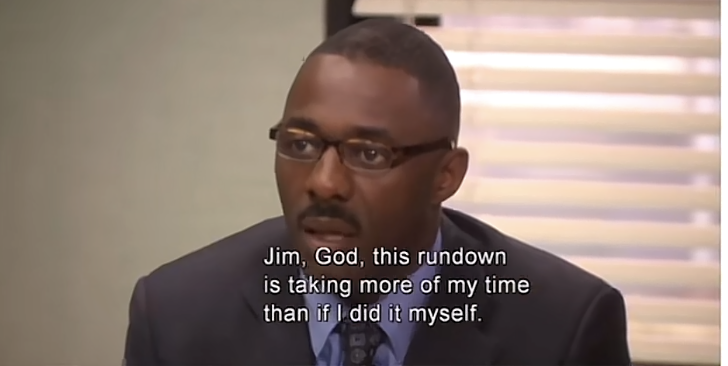
If you've seen The Office, you might remember the scene where Charles Miner, the new boss hired to increase performance at Dunder Mifflin, asks Jim to "put together a rundown" of his client information. It’s one of my favorite examples of what ineffective delegation looks like in action (if you haven’t seen it, it's worth a quick watch before you keep reading).
In this scene, Charles provides no explanation of what a rundown is or what it should include, and with no deadline beyond "get it to me”, Jim begins to spin out. Why? Because Jim desperately wants to impress Charles, worried he’ll look incompetent if he admits he has no clue what Charles means by “rundown”. Instead of asking for clarification, he spends the better part of the day fishing for clues on the sly, half-asking coworkers, and essentially makes zero progress. When Jim finally hands something over, Charles doesn't even look at it. He just tells Jim to send it to "the distribution list." Jim doesn't know what that is either, and by this point he's fully exasperated, so instead of asking, he faxes his supposed rundown to his father. As is typical with The Office, we watch someone waste the whole day doing a lot of nothing.
The Office gives us a comedic interpretation of the workplace, but what makes it so funny is that we can still see a little bit of our own lives in the plot. While we may not all get to experience someone like Michael Scott leading our training, we all know the feeling of corporate mandatory training. And in the case of Charles Miner’s rundown, there’s something relatable to most of us here:
Most managers are bad delegators. Leaders often delegate tasks as a quick “what”, without the “why” or “how”. They assume their intent is clear. They think executive presence equals using the fewest numbers of words, generally amounting to vague buzzword soup. But when the recipient lacks context—and fears asking for it—they spin their wheels trying to figure it out instead of simply getting it done.
In other words: delegation is too often optimized only for speed and mental offloading in service of the manager instead of capacity-building of the employee.

Disclaimer: You’re Charles, Not Jim
This The Office scene is framed around Jim’s experience. We empathize with him, feel confused with him, and are nervous for him. This is because we all know what it’s like to be Jim, and we know what it’s like to get a vague or unclear ask from our manager.
If you are reading this as a manager or leader, though, you have to remember that you are not Jim. You are now Charles.
You may not see yourself as being intimidating, elusive, or powerful. You likely see yourself being efficient, trusting the other person to figure it out, or giving them room to grow.
Truth is: Your team is likely more intimidated by you than you could possibly understand.
They will not always tell you when they are confused. They may worry that asking another question will make them look inexperienced, unprepared, or incapable. You hold more power in the conversation, which means you also hold more responsibility for making the expectations clear.
Charles doesn’t see himself as unclear either.
I see this constantly across the leaders I coach and the managers I train, from someone three months into their first team lead role to experienced executives and founders who have been running teams for years, frustrated by how much they have to chase people down to get things done. A task gets handed off, the leader assumes the ask is obvious, and later it doesn't come back right.
Most managers come to believe that delegation is not worth their time because they could do it faster themselves. They believe the person who dropped it wasn't accountable, doesn’t care, wasn't enough of an owner, wasn't the right hire. Look closer, and a different explanation starts to look more accurate: the person wasn't careless. They were confused, and nervous about what the leader (yes, that’s you!) would think of them if they asked too many questions or didn’t understand on the first go.
Introducing PRIME
I love frameworks. They create scaffolding to help leaders structure their thinking for better outcomes. When it comes to delegation, there is a great framework in Skill x Will for deciding what to delegate, but there’s no dedicated framework for teaching someone how to delegate.
I built PRIME to close that specific gap. The word prime has many meanings, but the cue here is “to prepare”. Priming in psychology means “exposure to one stimulus that influences how you respond to a later, related stimulus without conscious awareness”.
When you delegate a task or initiative without setting clear expectations, the recipient of that task is naturally primed with whatever perspective they already have in the world. When you add in a PRIME layer, you provide a new frame and new lens that will influence how they respond and carry out the task itself.
In PRIME, each letter corresponds to a word, and each word serves a different purpose along the Five-W question types.
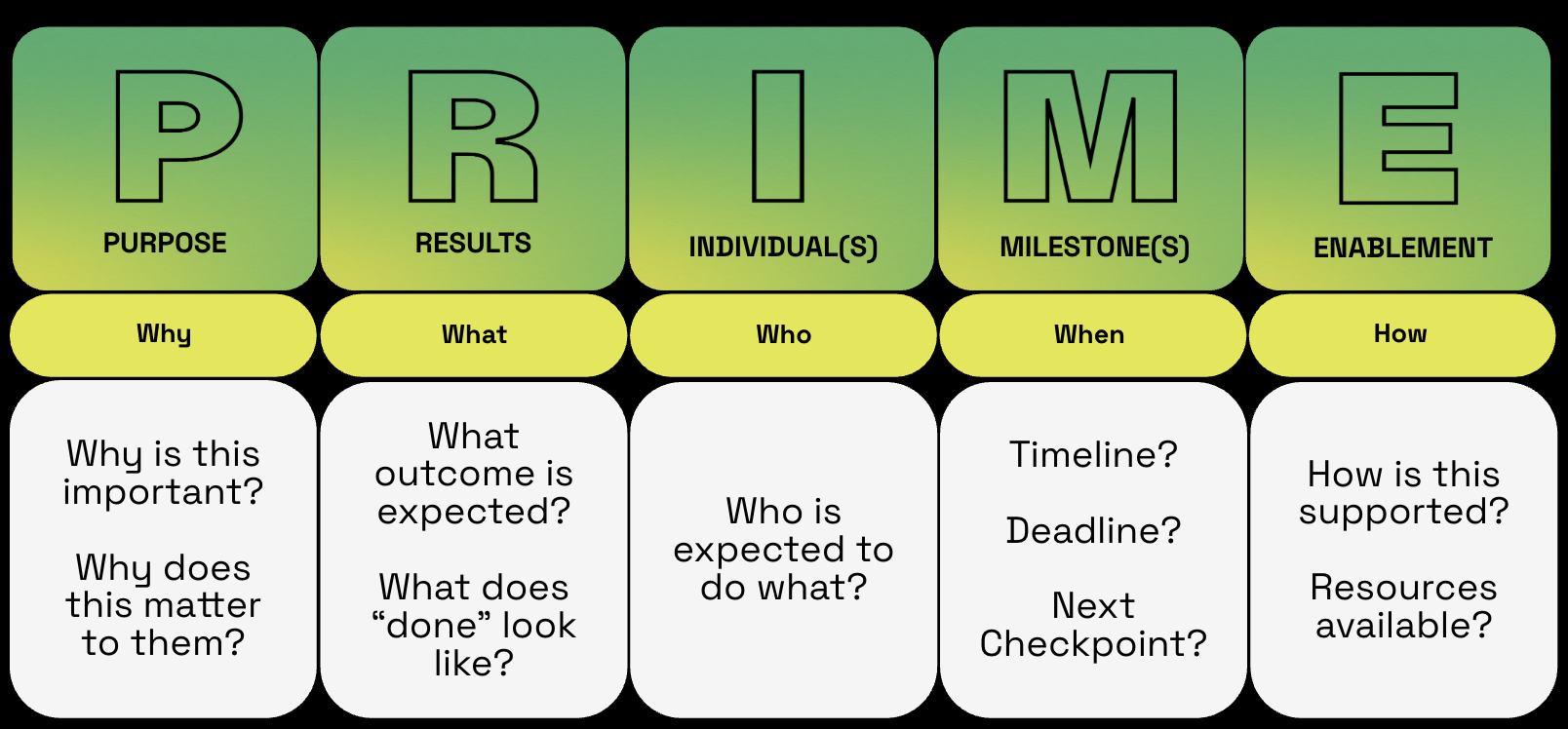
Before you delegate, get clear on your answers to each PRIME segement. Transform a soulless handoff into an opportunity by connecting the task to the bigger picture and clarifying ownership, timelines, and resources.
First, as aligned with the Skill x Will framework, this is your opportunity to motivate by providing context that connects this ask to the company mission or topline priorities. You might even acknowledge the "why" behind choosing them, acknowledging their desire for stretch opportunities or a skill they bring to the initiative that led to their being selected.
Next, this is your chance to name the desired outcome, provide examples of what's been done before, or paint a picture of what excellent means to you. From there, quickly ensure they understand what's expected of them and if any other people will be involved and proactively align on the deadline or next checkpoint. Finally, show how they are set up for success by naming any resources, tools, or help available to them.
You don't need a heavy monologue to deliver the ask. Adjust your approach based on the person: a junior employee might need you to guide them through the full PRIME framework as scaffolding, while you might motivate and inspire a senior employee with Purpose, and invite them to co-create the final “RIME” with you for clear alignment on the output. Use your judgment to meet them where they are, but the key is to meet them and guide them through the full PRIME to ensure the ask is clear and the employee is aligned.
Replaying the Charles and Jim Scene
Let’s go back to the scene where Jim was too afraid to ask Charles what a Rundown was. Charles' brevity of a ten-second ask resulted in seven hours of Jim’s unproductivity. If he instead spent one minute with a PRIME ask, Jim could have completed the taskin under an hour:
- Purpose: The Dunder Mifflin Marketing team is putting together case studies of our most successful clients. There are great options in your client portfolio.
- Result: Can you put together a rundown of your clients? Ideally a list outlining the client, total revenue, products purchased, key champions, and your comment on if they’d be a good case study.
- Individual(s): I want you to own this end-to-end- it’s a simple ask.
- Milestone(s): End of Day- This is an hourlong task - don’t overthink it. Just send it to the Distribution List for the Marketing Team.
- Enablement: Here is a copy of Phyllis' rundown you can use as a template. Any questions?

When to use PRIME
At this point, you may be thinking: Do I really need to use PRIME every time I ask someone to do something?
No. There are plenty of moments when PRIME is overkill.
You probably do not need PRIME when:
- Someone has done the task before and is simply doing another round of it.
- They already understand the context and know what great looks like.
- It's a simple binary task, like, "will you attend X meeting next week?"
In those cases, you may only need to say, “Happy to answer any questions.”
You should use PRIME when:
- Someone is taking on something brand new or ambiguous.
- You are handing off work that used to belong to you.
- The ask is high stakes and it's not worth risking a miss
Those are the moments when it is worth spending an extra minute to PRIME the person before they get started.
Takeaways
Delegation and expectations setting are notoriously tough for people managers. Managers feel the pressure from all sides, and in today’s urgency minded workplace culture, brevity and speed are celebrated over slowing down to explain. No one has time for it.
Your decision to delegate could stem from a need to take something off your own plate, passing along an ask from elsewhere, or, a desire to grow and develop your team. Regardless of the reason, everyone benefits when you PRIME the other person being asked.
Does it take five extra minutes to reflect on what your answers might be to each of the components and then spell it out for the other person? Yes, and five extra minutes that can save you and the person delegated hours or days of additional headache is a worthy ROI in my book.
PRIME them to be successful, so they start running, not spinning out.

