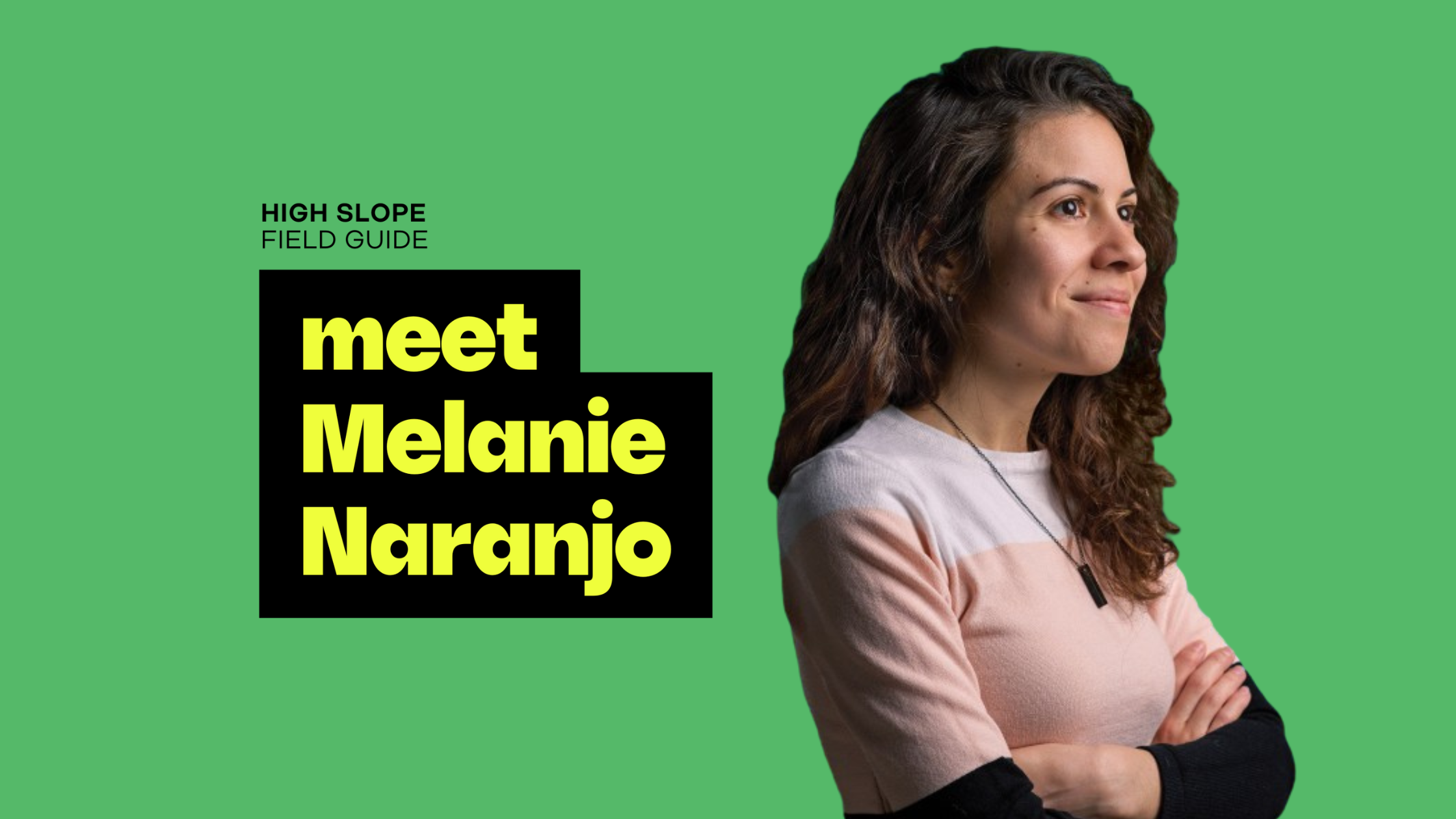
High Slope Field Guide: Meet Melanie Naranjo
Editor
Heather Doshay
Category
High Slope Field Guide
Date
February 4, 2026


.svg)


"I don't know if I've ever had a moment where I was like, yeah, I'm ahead of the game."
Melanie Naranjo does not see herself as High Slope. Everyone else around her does.
Melanie Naranjo is the HR executive other HR executives admire. With nearly 75,000 LinkedIn followers and an insightful, witty podcast, she's a recognized voice. She grew her People career from new graduate to VP in just five years. While she attributes her success to career passion and hard work, her accomplishments far surpass those of most people who work just as hard.
But her drive is more than ambition. She’s building a legacy. Melanie describes, “I think there's part of it, that first generation immigrant mentality… My mom was a babysitter her whole life, you know, taking care of other people's kids, and I'm so privileged to have a corporate job and be able to be financially independent. It's a great privilege to have this opportunity. And I kind of want to do it for my mom, myself, my whole family… this opportunity that I have that they never did.”
Melanie is textbook High Slope coupled with a deep sense of purpose.
The checklist problem
When first talking to Melanie about the PEAKS traits and which one she resonates with most, Melanie hesitated.
She struggled with the question itself, because each trait was seen as standalone in this way. It turned the framework into a checklist, and she insightfully pointed out the difference.
For her, the key is in how they work together. They are interconnected parts of the same system. Separate them, and you lose what makes them useful.
As humans, we gravitate toward checklists for good reasons. They reduce cognitive load and offer a quick sense of progress when the task feels too big. But they also flatten important nuances which are antithetical to systems thinking (ironically, a single PEAKS trait).
The best organizations and leaders can name those tensions and hold them without pretending they do not exist. Melanie learned that lesson first in herself.
When superpowers are weaknesses
Early in her career, Melanie’s defining PEAKS trait was persistence. She would run through walls to turn ideas into finished work. She was seen as a person who got things done, or so she thought. She notes that persistence requires focus, and sometimes that single-mindedness could result in her seeing alternative viewpoints as distraction. Could she actually be solving the wrong problem and now persistence is unproductive? Would she get to a better solution if she leaned into the ideas of others?
She did not need less persistence, she needed a counterweight. For Melanie, that counterweight is curiosity, listening, and an openness to being wrong. Those elements map to the K in PEAKS, “knowledge sponge.”
When someone is High Slope, their PEAKS traits are generally jaw-droppingly strong. But what Melanie challenges is equally important: all the pieces must be there, even if in moderation. If they are out of balance, superpowers can instead become an Achilles’ heel.
She found that overreliance on one trait could have halted her career. Treating each trait as isolated, as a part of a checklist, is missing the point. She shares a lesson to acknowledge and integrate the healthy tension between all things and not see development as a checklist.
The role of managers
Managing High Slope Talent looks like a dream from the outside. These people grow and adapt their skills to the growth of the company, with capabilities that make them hyper effective.They are high achievers who get things done without a lot of direction.
A lot of managers mistake this as an easy “set and forget” management hack. Just hire High Slope Talent and get out of their way. It gives them time to focus on the underperformers who are struggling. For Melanie, this is a total missed opportunity.
Melanie credits management as critical to her career journey. And there’s a catch beyond that: she noticed that what she needed in management evolved tremendously throughout the course of her career.
When she was early career she thrived on the autonomy she was afforded, but lacked the feedback she needed. Her favorite moments were when her manager said to her “I don't have time for this. Can you figure it out and just put it together?” She explained, “ I love that because that's how I learn.”
However, autonomy alone isn’t enough for an early career hire. She notes,
“I do wish I had gotten more constructive feedback, because that's how I'm wired. I want to know what I can do better. I don't think I got enough of that, which I think is common for a lot of high performers and overachievers. It's like, [managers are] distracted by all these people who are underperforming.”
This is a common failure. Managers treat high performers as low-maintenance and spend their coaching time where the pain is loudest. Meanwhile, the High Slope person gets praise, more work, and vague encouragement to “keep it up.”
Melanie wished her manager had said:
“Hey, you're working harder, not smarter… I'm not measuring you on how hard you're working. I'm measuring you on the impact of your work. You could have done that with less investment.”
High Slope Talent wants to grow and improve. “Great job” doesn’t cut it, they want to know where they can continue to grow, even if it already looks like they are growing.
The most surprising and important revelation, however, was what she realized in her transition into executive leadership.
Senior executives need managers too
Senior leadership is where management often disappears. People assume that if you made it to VP, you’re the expert of the department and totally self-sufficient. You don’t need challenge and support. Management at this stage often becomes a transactional accountability relationship. This is especially true in startups where the founder and CEO of the company is often younger and less experienced than any of their executive direct reports.
High Slope Talent doesn’t have to plateau as executives. They still want feedback and growth, even when it seems like they are at the top of their game.
Melanie names an important truth for her, and many executives:
“Too many people overlook the importance of motivating and empowering your senior leadership… the more senior you get, the more lonely it gets, the fewer people that you can sort of confide in or talk to.”
To maximize the performance of your organization with High Slope Talent, it’s important to recognize that managers play an important role at every stage of a person’s career. Melanie shares how impactful and deep her relationship with her CEO Roxanne is:
“Those moments mean so much to me… when my CEO takes a moment to be like, ‘Hey, let's talk about you. You are really good at this, has anybody told you that? Let's do more of that.’ It just means so much.”
Even though it looks like Melanie is at the peak of the mountain from the outside, she sees herself as “just on the journey” and is highly motivated by acknowledgement and the challenge to continue to lean into her strengths.
Tips for motivating High Slope Talent
Melanie has a word of caution: what worked for Melanie is not a playbook for the next High Slope Leader you hire. Everyone is wired differently. Some of it might land and some might not. The goal is to stay curious about what motivates the person and keep the conversation evolving as they grow. Some people want clear guardrails; others want total freedom. Some crave blunt critique; others need more praise. Some want a bigger title; others want flexibility. High Slope Talent will usually perform well enough either way, but there’s nuance in unlocking their best work.
So what do you do? Melanie’s advice is simple: ask directly, and keep asking. Start with, “What motivates you most in your work?” and make it easier by offering a few options without judgment so it doesn’t feel like a test: money, flexibility, growth opportunities, title, or something else. Then listen, calibrate your mix of challenge and support around what you hear, and revisit the answer over time, because what someone needs will change as their career changes.
That’s why High Slope can look obvious from the outside: promotion velocity, PEAKS traits that floor you, raving fans and followers. Checklists can help you assess it, but they won’t unlock it. The key is learning the system for the person in front of you, what motivates them and how that shifts as they grow.

