
What's the Difference Between Coaching and Advising?

Editor
Heather Doshay
Category
Ask Waypoint
Date
October 19, 2026


The conversation usually goes like this:
Leader: “I think I need a coach.”
Me: “What are you hoping to gain from coaching?”
Leader: “I want to be a better leader. I’m missing key skills and want a coach who can give me the right tools, frameworks, and advice so I can succeed.”
That's a reasonable thing to want; it just isn't leadership coaching. What they're describing is advising or mentorship, which I use interchangeably here, because for this question they work the same way: someone with more experience helps guide you to figure out what to do.
People call a lot of things “coaching," and it’s diluted the label of leadership coach to a point that it sometimes comes across as an elusive practice reserved only for the privileged few.
I believe every leader deserves a village of support: coaching, advising, mentoring, training, and community. Just as your business has multiple channels for revenue growth, you deserve multiple channels for leadership growth.
The goal of this post is to clarify the difference between a few words that get confused a lot, so you can effectively build up the right support system around you as a leader.
A word with a lot of jobs
When most people hear the word "coach," they think of sports. In any sport, the role of a coach is to train, guide, and motivate athletes to improve their skills and performance, build teamwork, and achieve competitive success. It's natural to expect the same from a coach in business.
However, when you hire a leadership or executive coach certified by the International Coaching Federation (ICF), you're signing up for a distinct discipline, with its own training, ethics, and core competencies. According to the ICF, advising and mentoring are specifically not the job. A certified coach listens deeply and draws on powerful questions, observations, intuition, and guided exercises to help you uncover patterns, challenge assumptions, and find your way forward, with you as the expert on your own context.
The picture by my desk
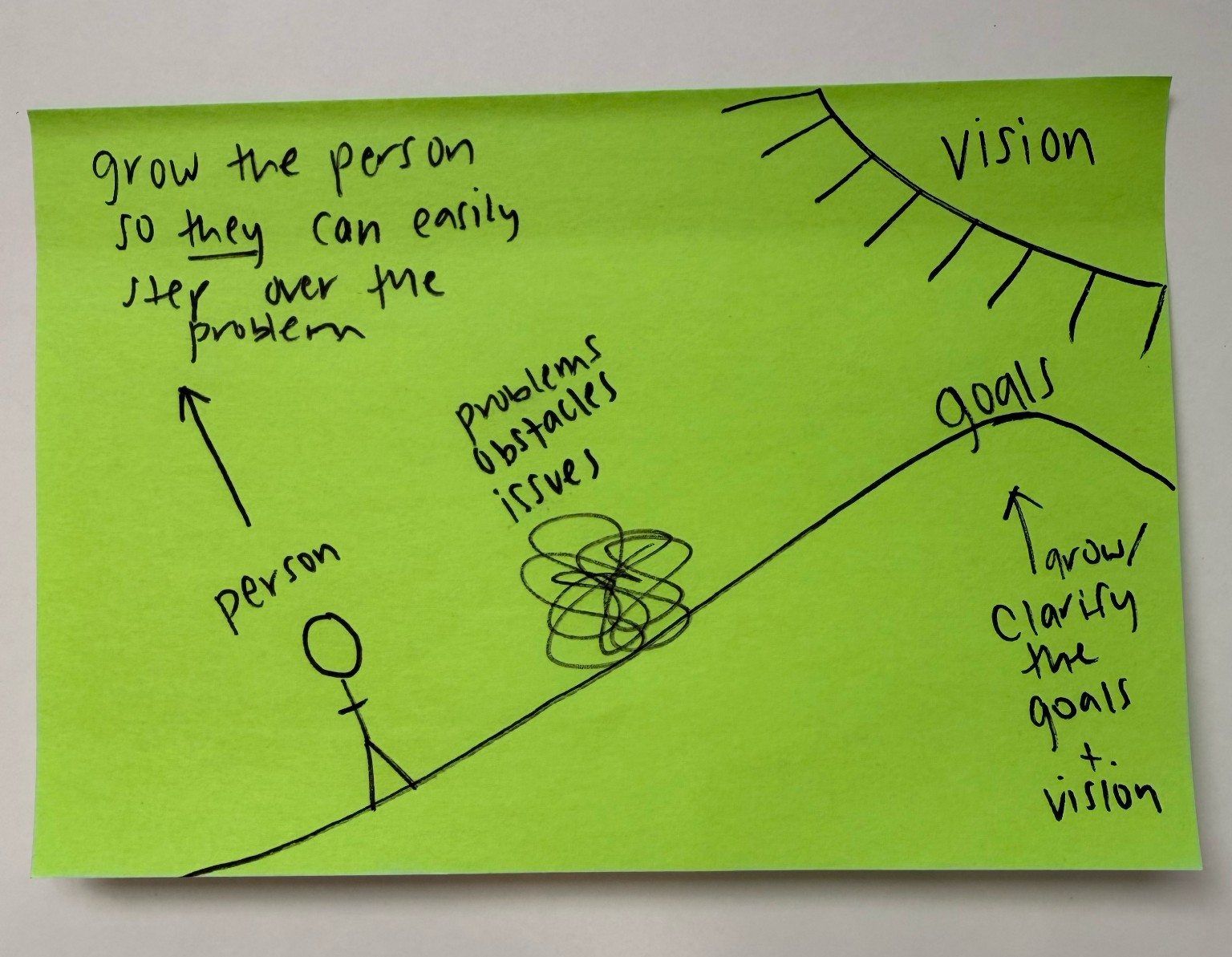
I keep a stick figure drawing on a post-it on my computer monitor that I come back to whenever I explain what coaching is. A person is climbing a mountain. At the peak is the sun, which stands for their vision, the thing they're trying to build or become. Between them and the summit sits a big tangled scribble on the trail. It’s “the mess”: the problems, obstacles, or issues they see getting in the way of their goals and vision. From where the person stands, the scribble looks bigger than they are, and on bad days it blocks the view of the peak altogether.
Coaching and advising/mentorship both help solve parts of this picture, but they focus on totally different areas of the landscape.
Advising makes the mess smaller
An advisor is someone who has climbed this trail before. Mentors, consultants, fractional executives, and embedded advisors all belong here. They know how companies scale and what tends to break along the way, and they've walked other leaders through terrain much like yours. When you bring them the tangle, they help you take it apart: here's how others have handled it, here's a framework for the decision, here are your 3 realistic options and what each will cost you. Sometimes they'll roll up their sleeves and build the thing alongside you.
Relief comes quickly, because the attention stays on the problem. You'll grow along the way, picking up skills and a more developed sense of what good looks like, but that growth is a side effect. The main event is getting the mess out of your path so you can keep climbing.
Coaching makes you and the vision bigger
Coaching puts its attention on the other two parts of the drawing: you and the sun.
The mess is just context and noise. As your sense of what you want gets clearer and your capacity to meet it grows, the scribble shrinks in proportion, until one day you are so big it's small enough to step over. You'll know how to handle future messes of greater sizes as you continue to grow within yourself.
Most coaching conversations circle 3 questions: What do you want? What are you choosing? What are you experiencing right now? A good coach listens closely enough to notice what you can't see from inside your own head, like the assumption you see as objective truth, the pattern you keep running into, or the shift in your voice when a certain person comes up. They may ask what's happening in your body as you talk, since tension and energy often register there before they show up in words. The answers come from you versus the coach, and the coach's skill lies in helping you find them faster and see them more clearly than you would alone. Every session ends with a way forward, which might be an action to take or a question to reflect on until you meet again.
The tradeoff with coaching is pace. You might arrive at a session wanting to solve the problem in front of you (what you are doing about the mess), and find yourself spending the full hour focused on who you are being instead. You leave a little taller than you came in, maybe not yet tall enough to step over the mess, but that growth accumulates, and it travels with you to every type of problem that follows.
There’s research behind this approach: an fMRI study found different patterns of brain activity following coaching focused on hopes and aspirations versus weaknesses and external expectations. The researchers associated the aspiration-focused pattern with visioning and positive emotion.
Where therapy fits
Clients sometimes tell me a coaching session felt a bit like therapy, and I understand why. Both look at the whole person, deep emotions come up in both, and the client does more talking than the coach or therapist does. But these practices require different training and serve different purposes. Coaching helps you understand what you're experiencing, clarify what you want, and choose how to move forward. Therapy can also support those goals, while addressing mental health concerns and exploring where your patterns come from. A coaching credential does not qualify someone to diagnose or treat mental health conditions, though some coaches are also licensed therapists. Many leaders choose to work with both a coach and a therapist at the same time, and if you have the time and financial resources, I highly recommend you do.
Summary table

Choosing what you need now
When the mess is burying you, it's natural to want it gone, and that's what advising is built for. But before you decide, ask yourself one more question: what do you most want this investment to help you do?
Advising is probably the better fit if:
- You want tools, frameworks, or recommendations from someone who has navigated challenges like yours.
- You’re facing an operational problem and need help evaluating options or putting a solution into practice.
- Your priority is making progress quickly with experienced guidance.
Coaching is probably the better fit if:
- You want to understand and change patterns in how you lead, make decisions, or respond under pressure.
- You’re unsure what you want, or you know what you want and keep getting in your own way.
- You want to develop greater self-awareness, confidence, and capacity to navigate challenges on your own terms.
Neither is inherently the better investment. The value depends on what you want to gain and whether the support you choose is designed to help you get there. If you have the time and financial resources for both, bring both into your circle. That village of support gives you access to experienced guidance alongside dedicated space for your own discovery and growth.
Once you know what you’re looking for, look beyond the title. For advising, ask about relevant operating experience: has this person navigated the kinds of decisions and challenges you’re facing? For coaching, ask about coaching-specific training, credentials, and how they practice. Coaching training alone doesn’t establish someone’s expertise as an advisor, and operating experience alone doesn’t establish their skill as a coach.
Some practitioners, myself included, have both backgrounds and offer coaching and advising as distinct services. We can agree to draw on both, but the distinction still applies within a session: when I offer a recommendation from my experience, I’m advising; when I help you discover your own answer through coaching, I’m coaching. Switching approaches should be an explicit choice we make together based on what would serve you.
Before you commit, make sure you and the practitioner agree on what you’re working toward, which kind of support you’re paying for, and how you’ll handle any shifts between the two.
Both will keep you climbing. Advising clears the trail in front of you, and coaching changes the size of the person walking it.

